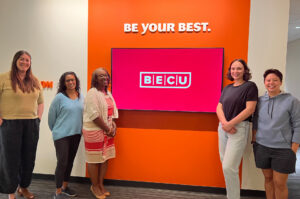
As College Possible Washington celebrates twenty years of service, we’re excited to honor the partners who’ve helped support our mission. One of those partners is BECU, whose steadfast commitment to advancing college access for King County students has made a lasting impact.
A Shared Commitment to Community Financial Health
While it may not be clear at first what a local credit union and a nonprofit have in common, a closer look shows that BECU and College Possible clearly align on their priorities for the community. Through their respective work, both are aiming to improve individuals’ financial health and, in turn, that of their communities.
Tisha Held, BECU’s philanthropy and foundation manager who oversees the organization’s postsecondary education and college access portfolio, described the credit union’s giving strategy this way:
“Financial literacy, financial wellness, and financial freedom are our north stars in guiding us in how we interact with any organization.”
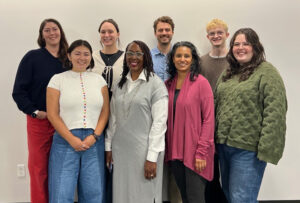
BECU further outlines its strategy for advancing these north stars in its 2025 Annual Report. Among six defined giving priorities, one is post-secondary education and college access, with the reasoning that, “a degree or credential opens the door to higher lifetime earnings and a network for future success” (BECU, 2025).
Elaborating on this priority, Tisha says:
“Education is such a huge foundation for how so many individuals can get financial freedom. Through college, students have more opportunities to pursue careers that help elevate their lives and create opportunities for generations to come.”
The Data on Degrees and Earnings
The relationship between higher education and financial wellness isn’t just sound reasoning; the data shows a clear link between a college degree and higher earnings. The median income for someone with a bachelor’s degree is $80,000, compared to $47,000 for someone whose education ended with high school (U.S. Bureau of Labor Statistics, 2025).
College Possible’s most recent Alumni Report points to the same conclusion. The survey found that 50% of College Possible alums earn more than $60,000 annually, nearly four times the U.S. poverty line, with 14% earning over $95,000. Additionally, a strong majority (71%) are saving for retirement. You can check out more findings from the College Possible Alumni Report here.
When students from low-income backgrounds have the tools, resources, and support to earn a college degree, it offers tremendous opportunity and upward mobility, a goal BECU and College Possible are enthusiastically pursuing together.
A Decade of Impact
College Possible is honored to have partnered with BECU since 2016. Over the past ten years, BECU has generously invested over half a million dollars, support that has made a meaningful difference in our efforts to advance access to higher education. Most recently, they awarded College Possible Washington a $75,000 grant to support the 2026-27 school year.
While reflecting on this partnership, Tisha shares a moment that has stuck with her:
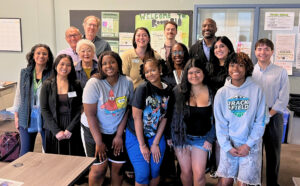
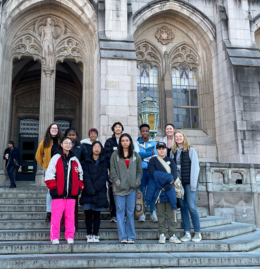
“When I went to Franklin High School and was able to hear the stories of how students connected with their [College Possible] advisor, and learn how it impacted them, it really solidified how important and powerful it is to have someone who is there walking [students] through this process.”
Beyond financial support, BECU staff historically shared their expertise by hosting financial literacy workshops for College Possible AmeriCorps volunteers. Most AmeriCorps coaches were young professionals eager to learn more about topics like saving for retirement or investing in the stock market, and they welcomed the chance to build those skills.
College Possible Washington is grateful for ten years of collaboration with BECU. We strongly believe that this work can only be done in partnership, and BECU has proven to be an invaluable steward of our mission to advance access to higher education for students from low-income backgrounds. Our organization looks forward to delivering more impact together.
Thank you, BECU.